The Dochain House
aka The Manor
Listed monument — Marche-en-Famenne

Listed monument — Marche-en-Famenne
Chapter I
The Dochain House, commonly called The Manor, is a listed building located at number 2 Manor Street, at the corner of Carmes Street, in the historic heart of Marche-en-Famenne. It is one of the oldest civil buildings still standing in the town and is among the few listed buildings in the province of Luxembourg.
The building takes its name from the d’Ochain family, who owned it in the 17th century. The street along it, formerly called Victor Libert Street, was renamed “Manor Street” in reference to the house.
✦ ✦ ✦
Chapter II
Although the four facade anchors date the building to 1616, older elements have been preserved in the foundation — proof that a previous structure already existed on this site. The visible building today was reconstructed after the great fire of 1615, which destroyed a large part of the town of Marche-en-Famenne, including Saint-Remacle Church.
“Magnificent house rebuilt after the great fire of 1615,
one can still admire a remarkable 17th-century fireplace and period furniture.”
Maison du Tourisme Famenne-Ardenne
The reconstruction uses the noble materials of the time: limestone rubble for the foundation, window frames, horizontal bands, and corners, and brick for the rest of the building. These materials reflect the status of its owners: influential notables who could afford the best.
The main facade has six bays and two levels. The windows are adjacent, under straight lintels, with shaped mullions. A four-sided slate roof, pierced with dormers, covers the whole — typical of the Mosan style and civil architecture of the region in the early 17th century.
Before 1615
An earlier building already occupied the site. Its remains are still visible in the foundation of the current house.
1615
The great fire of Marche-en-Famenne destroys a large part of the town, including the original building and Saint-Remacle Church.
1616
Reconstruction of the Dochain House in limestone and brick. The four facade anchors bear the date of this reconstruction. The building belonged to the d'Ochain family from the Liège Condroz.
17th – 18th century
The d'Ochain family held important political offices in Marche: alderman, provost, mayor. They owned other properties in the region, including the farm-castle of Aye. The Manor was at the heart of the town’s civil and political life.
1878
Significant transformation: the windows of the second and third bays from the left were converted into doors, with addition of small wrought iron balconies inscribed “1616 – JD – 1878”. Other modifications took place in the second half of the 19th century.
1976
Listed as a Walloon heritage property. The building is recognized for its exceptional historical and architectural value.
2023
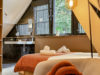
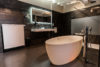
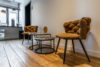
Purchased and fully renovated by two young couples. Reopened as a hotel-restaurant with 10 rooms and suites, respecting the listed monument.
Chapter III
The name “Dochain” is a contraction of “d’Ochain.” The family originated from the village of Ochain in the Liège Condroz (present-day municipality of Clavier), where the Ochain Castle still stands, with its main facade dating from the 17th century.
In Marche-en-Famenne, the d’Ochain family held several high-ranking political offices: alderman, provost, and mayor. This political influence went hand in hand with a considerable property portfolio: the family owned many properties in the town and region, including the farm-castle of Aye.
“The building owes its name to the influential d’Ochain family, who once owned it in the 17th century. The family held several important political offices in Marche (alderman, provost, mayor) and possessed several notable properties.”
Cirkwi — Cycling tour around Marche-en-Famenne
The d’Ochain family coat of arms is described by the heraldist Rietstap as: Gules with two silver leopards passant, one above the other. Their influence extended well beyond Marche, with connections in the Condroz and Liège nobility.
Chapter IV
The Dochain House is described by official tourist sources as a “Renaissance-style residence”, surrounded by a small garden and enclosed by a fence. Its architecture shows the characteristic features of quality civil construction in the region at the beginning of the 17th century.
Materials: The foundation, window frames, horizontal bands, and corners are made of limestone rubble. The rest of the building is brick. This limestone/brick combination was the distinctive mark of bourgeois and noble residences of the region at the time.
Main facade: Six bays, two levels (ground floor and one upper floor). Windows are grouped four in the left bays and two in the right bays, under straight lintels with shaped mullions. Horizontal bands along lintels, sills, and between lintels and sills link the windows together.
Roof: Slate, four-sided, pierced with dormers. This type of roof is characteristic of Mosan and Ardennes architecture.
19th-century modifications: In 1878, the second and third bays from the left were transformed: the windows became doors, with small wrought iron balconies added. These bear the inscription “1616 – JD – 1878”, recalling the original date and that of the modifications.
Interior: The residence retains a remarkable 17th-century fireplace and period furniture, direct testimony to its former splendor. The rear facade has blocked or altered windows from various periods; the side facades are less pierced.
Chapter V
Marche-en-Famenne is a former medieval fortified town whose walls were dismantled under Louis XIV. Ideally located on the main route between Namur and Luxembourg, it received its town charter in the 13th century. By the end of that century, it had a complete defensive system with two gates, watchtowers, and a keep.
In 1615, a great fire destroyed a large part of the town center, including Saint-Remacle Church (rebuilt with a Baroque tower dating from 1715). It was in this reconstruction context that the Dochain House was rebuilt in 1616, using limestone and brick — noble materials reflecting the ambition of its owners.
Other notable buildings in the town include: the Maison Jadot (17th and 18th centuries), the Îlot Dourt, the remains of the Carmes convent (founded in 1473), the former Jesuit church (listed in 1985, now part of the Quartier Latin hotel), and the Juniesse Tower, the last vestige of the medieval fortifications.
Today, Marche-en-Famenne is at the heart of the UNESCO Global Geopark Famenne-Ardenne. The town hosts the WEX (Wallonia Expo), the province’s main convention center, and is surrounded by exceptional natural sites: the Fond des Vaulx, the limestone grasslands of the Calestienne, and numerous caves in the region.